
Ocean Aid 360 (OA360) was founded in 2017 in St. Petersburg, Florida, when co-founders Neill Holland and Danielle Dawley combined their respective passions for fishing and marine debris removal into a targeted marine restoration program. At the start, the OA360 team focused their efforts on the removal of marine debris and derelict traps in the Tampa Bay estuary – an area that is critically important for commercial and recreational fishing. Since then, they have expanded their efforts to every corner of Florida’s coasts and the Bahamas. With the help of a volunteer team over 2,500 strong, OA360 has recovered 601,000 lbs of debris and retrieved 8,500 traps over the past eight years.
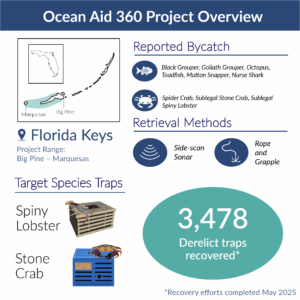
As a project partner of the National TRAP program, Ocean Aid 360 is expanding their range and targeting the lower Florida Keys, covering waters between the Big Pine and Marquesas Keys. The team keeps their eyes peeled for the two most common trap types in the area – stone crab and spiny lobster traps. Tropical storms are known to sweep these traps miles away from where they were initially set. Despite the best efforts of commercial fishermen, OA360 estimates that around 5% of commercial traps are lost annually in this area of the Keys, with this number increasing up to 10% when traps encounter conditions associated with named storms.
OA360 is already making big waves with their TRAP funding. In May of 2025 alone, the crew retrieved 3,478 derelict traps – this makes up a whopping 42% of all traps OA360 has recovered since 2017! The retrieval process has always been efficient, but as Captain Neill explains, the TRAP funding has allowed OA360 to take a “quantum leap in terms of the amount of traps removed in a short period of time.” A typical retrieval day begins with recovery groups coordinating with one another (using TRAP’s handy documentation app!) to ensure that they are targeting all new areas. Once they reach their target locations, the clear, shallow water of the Keys makes it easy for OA360 volunteers to spot most traps with sight alone, though the crew will occasionally use side-scan sonar to detect hidden traps. Once spotted, volunteers can retrieve traps using either a boat hook or snorkeling to retrieve by hand.
What makes OA360 such a well-oiled machine? Community engagement, of course! OA360 has brought together a combination of commercial fishermen, data collection volunteers, and passionate local residents to form a team that can recover traps at incredible rates. During retrieval expeditions, the crew pairs an experienced waterman with a data collector trained in standard metric protocol. The combined expertise ensures efficient, accurate, and safe trap retrievals. Captain Neill also notes that the success of OA360 depends on “the proper gear” and “thousands of passionate volunteers.”