Originally published by the NOAA Marine Debris Program on March 31, 2026
Note: It is illegal to handle sea turtles without a permit. This rescue was conducted under Florida Fish and Wildlife Conservation Commission (FWC) Marine Turtle Permit MTP-25-024. If you see a sea turtle in distress in Florida waters, please call FWC at 1-888-404-3922.
In summer 2025 in southern Biscayne Bay, efforts to remove lost fishing gear led to an unexpected rescue and a second chance for an endangered green sea turtle.
With support from a 2023 award from the NOAA Marine Debris Program, William and Mary’s Batten School and the Virginia Institute of Marine Science (VIMS) Nationwide TRAP Program, in partnership with the University of Florida Institute for Food and Agricultural Services (UF/IFAS) Extension Miami-Dade County Sea Grant Program, led a team to remove abandoned and derelict traps used to catch blue crab, stone crab, and spiny lobster from Biscayne National Park.
Blue crab fishing peaks during the summer months in the same nearshore waters where green sea turtles feed, increasing the risk of turtle entanglement in traps and lines. Unfortunately, this threat continues beyond the fishing season as derelict fishing gear, including lost, abandoned, or discarded traps and lines, poses a significant threat to sea turtles and other marine wildlife once it is no longer under the control of a commercial or recreational fisher. Wildlife can become entangled in derelict lines and nets, resulting in injury, infection, impaired mobility, drowning, and starvation. Removing abandoned traps and fishing lines helps safeguard important marine habitat, prevent entanglement, and reduce risks to endangered species including the green sea turtle, a species listed as endangered under the Endangered Species Act.
Representatives from Biscayne National Park, Miami-Dade County Department of Regulatory and Economic Resources, Coastal Cleanup Corporation, Fishing Spots Conservation, and University of Florida teamed up in summer 2025 to remove derelict traps near Black Point in southern Biscayne Bay. During this three-day, multi-agency operation, three crews worked from separate park vessels, visiting sites where traps had been reported. One crew operated in shallow waters of Biscayne Bay and retrieved stone crab and blue crab traps from the surface, while the other crews dove offshore for stone crab and spiny lobster traps. When a trap lacked a buoy, snorkelers attached a line so it could be pulled aboard. The removal took place during the closed season for all three trap fisheries. Under state regulations, any trap left in the water during this period is considered derelict and may be removed by permitted entities.
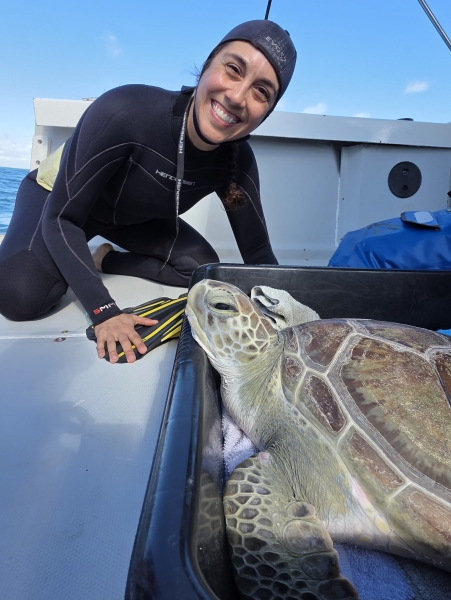
During the removal work, the shallow water crew encountered a juvenile male green sea turtle struggling in the water. The turtle was entangled in the buoy line of a derelict blue crab trap. Acting swiftly and in accordance with established laws and protocols (FWC Marine Turtle Permit MTP-25-024), Florida Sea Grant’s Ana Zangroniz and partners carefully freed the turtle from the heavy line wrapped around the turtle’s front flipper.
Upon closer examination, they discovered an additional and more serious concern: braided fishing line had become embedded deep within the same flipper.
Following guidance from the Florida Fish and Wildlife Conservation Commission, the turtle was transported safely to the Zoo Miami Sea Turtle Hospital for specialized care. Nicknamed “Oscar” after his safe ride back to shore in a large, repurposed trash can, he soon began receiving comprehensive treatment from veterinary staff and animal health specialists.
Veterinarians at Zoo Miami carefully removed the embedded fishing line, treated his wounds, and began monitoring his recovery. During his intake examination, the team also confirmed that Oscar was battling Fibropapillomatosis, a disease that causes golf-ball sized tumors to develop on sea turtles’ soft tissues and can make it hard for them to see, swim, and eat.
Over the next seven months, Oscar underwent five delicate surgeries to remove fibropapilloma tumors. Throughout his rehabilitation, he regained strength, swam actively, ate well, and responded positively to treatment. After receiving a clean bill of health from Zoo Miami veterinarians, and with support from wildlife biologists at Biscayne National Park, Oscar was released back into his home waters of Biscayne Bay in February 2026.
Oscar’s entanglement in lost fishing gear was the immediate crisis that brought him into human care. There was a silver lining, however: because he was rescued from one life-threatening danger, rescuers found and treated another serious health problem.
By removing the embedded fishing line and surgically addressing his tumors, the Zoo Miami veterinary team saved him from multiple threats that could have impacted his ability to survive in the wild. It is especially important to address and reduce issues for animals that are already endangered. Healthy green turtles are long-lived reptiles and can survive for 70 years or more in the wild. What began as a response to marine debris, ultimately gave this endangered turtle a renewed chance at living a full life into adulthood.
Back in his home in the shallow waters of Biscayne Bay, Oscar can once again forage among lush seagrass beds. His story is a testament to what coordinated marine debris removal and response partnerships can achieve. Each trap removed represents one less hazard in critical habitat for endangered species. Oscar’s recovery reinforces how proactive efforts can protect wildlife before harm occurs and how rapid response can turn a life-threatening entanglement into a second chance.
Sincere appreciation is extended to the dedicated field teams, veterinarians, wildlife biologists, and partners whose efforts made this successful rescue and release possible.
For more information about the Batten School & VIMS Nationwide TRAP Program and the efforts funded through this partnership, visit the NOAA Marine Debris Program website.