
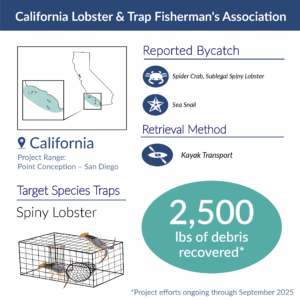
The California Lobster and Trap Fisherman’s Association (CLTFA) was established in 1994 as a 501(c)(6) nonprofit, and is committed to sustaining local fisheries while ensuring that they adhere to environmental regulations. CLTFA started as a grassroots intensive effort that removed washed-up debris along beaches and has since grown into a widespread organization that weaves consistent debris clean-ups into commercial fishing practices. The team has 53 active members as of August 2025 who collaborate with 141 active fishery permit holders in the state of California.
As a project partner for the National TRAP program, CLTFA removes lost fishing gear from beaches south of Point Conception down to San Diego, as well as in the Channel Islands. Severe swell events in recent years have increased the number of traps getting lost and washing ashore, which increases the likelihood of ghost fishing and other potential ecological hazards both in the water and on the beach. The team primarily recovers spiny lobster traps, but may also encounter crab traps or even live fishing traps on occasion.
A typical retrieval begins early, with crews (usually consisting of one captain and two paddlers) leaving between 5–6 a.m. Because the local fishermen are familiar with the area, they have a good idea of which locations to target in order to find the most derelict gear. Once they approach the trap sites, binoculars help locate ideal landing spots based on environmental cues such as the wind and tide direction. The crew anchors the boat, paddles the kayaks in at the right tide, and begins the longest part: aggregating and organizing the traps on the beach. Kayaks are then loaded to the brim with secured traps and hoisted back to the boat. Unless weather intervenes, the CLTFA crew never leaves without a full load of debris, stacked in impressive towers on their kayaks like gifts on the Grinch’s sleigh. Back at the harbor, traps are hoisted into a roll-off dumpster and then taken to be recycled. As a result of their efforts, CLTFA has retrieved around 2,500 lbs of debris over a one month period, and plans to recover significantly more by the time the grant ends in September 2025.
Because of the physical exertion and advanced skills required to recover derelict gear safely and effectively, CLTFA does not allow volunteers to participate during the actual retrieval process. However, the local community still plays a big role in derelict debris removal. To help zero in on trap locations, CLTFA has placed a series of flyers throughout Santa Barbara for residents to document and report derelict sightings. The team also collaborates with a local nonprofit, Tidy Seas, to help support the clean-up initiative.